 Dym
Dym tokenomics connects token distribution with changes in DYM supply
UpdatedDym tokenomics describes how DYM is allocated, released, issued and burned within Dymension. Its initial supply was 1,000,000,000 DYM, with allocations serving different purposes and release schedules. Subsequent issuance adds tokens, while protocol fee burns remove them. An unlock releases existing tokens from restrictions, so it can change their availability without increasing total supply.
A supply assessment needs both the amount of DYM that exists and the restrictions affecting its use. Allocation percentages describe the starting distribution. Later balances reflect releases, reward issuance, spending and burns, which affect different parts of that picture.
The short version: Unlocks release existing DYM, while issuance creates tokens and burns remove them, so unlocks affect availability without changing total supply.
Reconcile supply changes over a matching period
Start with total supply at the beginning and end of the same period, then account for minted and burned DYM. The closing amount should equal opening supply plus issuance minus burns, including any other recorded mint or burn events. A transfer between existing accounts moves tokens without creating them.
Circulating supply requires an additional definition: which existing balances does the measure exclude? Treasury holdings, vesting restrictions and bonded balances can receive different treatment. Keep that definition consistent across both observations. Otherwise, a classification change can look like new issuance even when the underlying token count hasn’t changed.
Genesis allocations served different purposes
The initial distribution separated public participation, development funding, incentives and early contributors. Its allocation percentages used the initial supply as their denominator:
- Public allocation: 8%, covering the Genesis Rolldrop and incentivized testnet.
- Ecosystem and research and development: 20%.
- Incentives Manager: 33%.
- Backers: 14%.
- Core Contributing Team: 20%.
The Community Pool received the remaining 5% of the initial supply as a treasury allocation. These categories describe intended recipients and purposes; they don’t establish present ownership or spending. The Incentives Manager and Community Pool were available to governance at genesis while classified as non-circulating.
Vesting schedules release existing allocations
Release timing differed between allocations, so one unlock date cannot describe the entire distribution.
Backers and contributing team
The genesis schedules for backers and the Core Contributing Team specified a 12-month lockup followed by 24 months of linear vesting. Those periods describe the original schedule, rather than time remaining today.
Public distribution and its exception
The Genesis Rolldrop and incentivized testnet allocations were generally unlocked at genesis. Validator participants in the incentivized testnet had an exception: a 12-month lockup followed by 24 months of linear vesting.
Ecosystem funding
The ecosystem and research and development allocation made 33% available immediately, with the remainder vesting linearly over three years. That percentage applies to this allocation, not the entire initial supply.
Staking participation influences new issuance
Dymension adjusts issuance using the proportion of total DYM staked relative to a configured target. Below that target, the issuance rate increases incrementally toward its upper bound. Above it, the rate decreases toward its lower bound. At the target, the rate remains unchanged.
RollApp bonds are excluded from the staking calculation that governs DYM issuance. Governance can change issuance parameters, so their numerical settings aren’t permanent token properties. The chain’s mint parameters and staking state determine the applicable calculation. The initial billion-token supply is therefore a starting quantity, not a fixed ceiling.
Reward distributions combine issuance with existing fees
Staking rewards can include newly issued DYM and transaction fees that users have already paid. Eligible validators and their delegators receive these distributions, with validator commission affecting the amount retained. The components have different supply effects: minting creates tokens, whereas distributing existing fees moves tokens between accounts. A reward payment therefore doesn’t establish how much new DYM entered supply.
Protocol fee flows determine the amount burned
Dymension burns DYM through designated bridging and swap fee mechanisms. The amount removed depends on chargeable activity, applicable parameters and any conversion into DYM. Total transaction volume alone doesn’t establish a burn amount.
RollApp withdrawal fees
Fees collected through Dymension’s RollApp bridging fee mechanism are converted into DYM and burned. The bridging fee is a governance-adjustable percentage of transferred tokens. In the withdrawal mechanism, liquidity providers bear this protocol charge, which is distinct from the priority tip paid for withdrawal fulfillment.
Swap fees and their recipients
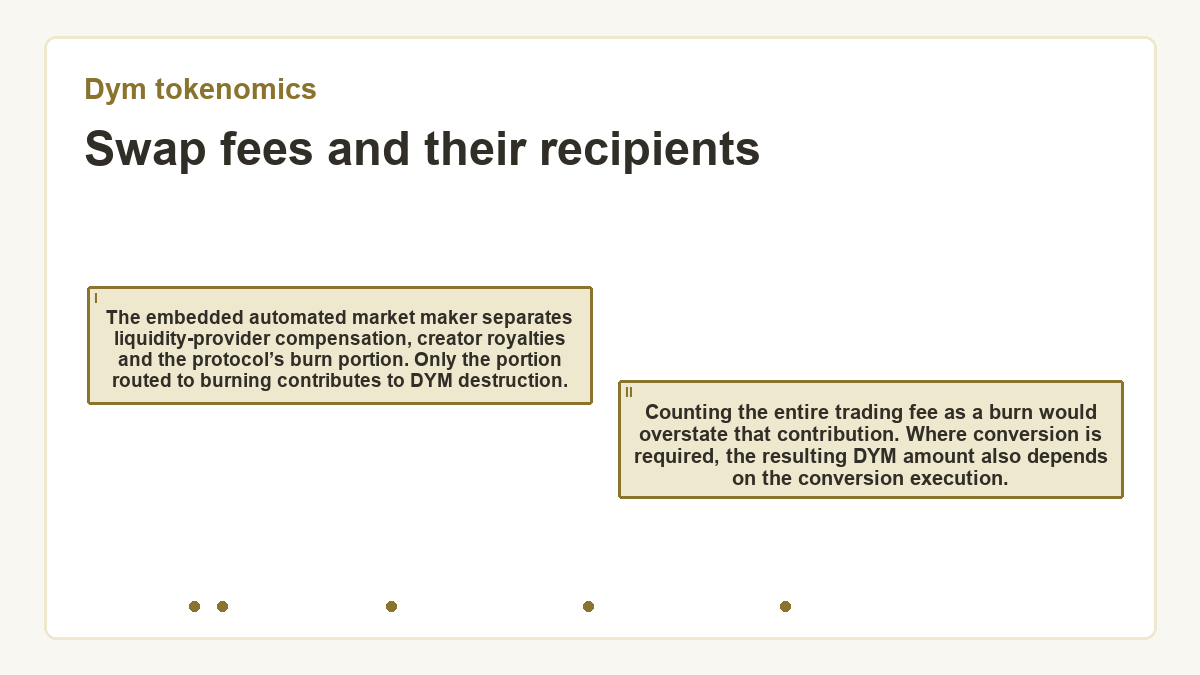
The embedded automated market maker separates liquidity-provider compensation, creator royalties and the protocol’s burn portion. Only the portion routed to burning contributes to DYM destruction. Counting the entire trading fee as a burn would overstate that contribution. Where conversion is required, the resulting DYM amount also depends on the conversion execution.
Bonded tokens remain part of total supply
RollApp sequencers bond DYM to support their role in proposing state updates. This restricts availability without destroying the bonded tokens. Validator staking likewise commits existing DYM rather than removing it through a burn. These commitments affect access to tokens, while the total-supply calculation continues to include them. A lower amount available for immediate movement can coexist with increasing total supply.
Incentive spending changes where DYM accumulates
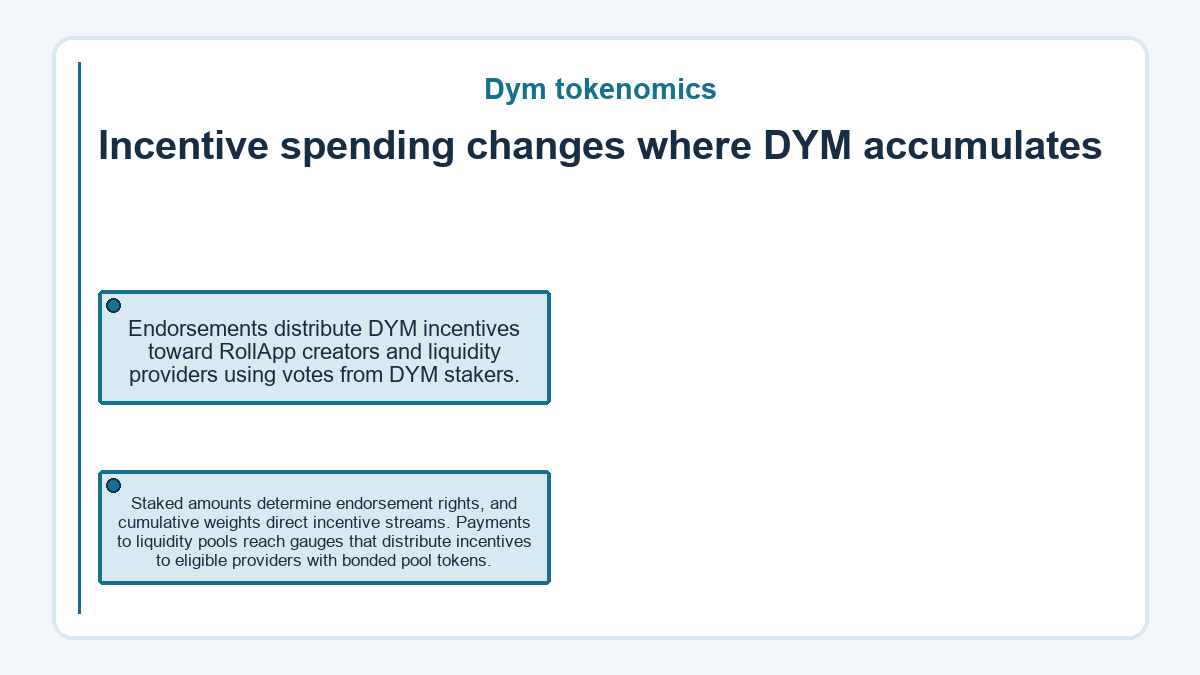
Endorsements distribute DYM incentives toward RollApp creators and liquidity providers using votes from DYM stakers. Staked amounts determine endorsement rights, and cumulative weights direct incentive streams. Payments to liquidity pools reach gauges that distribute incentives to eligible providers with bonded pool tokens.
A distribution funded from an existing reserve reduces that reserve while increasing recipient balances. It doesn’t create new DYM merely because recipients receive a reward. Treasury spending has the same accounting distinction. Governance can authorize transfers of protocol-owned funds, so allocation size and remaining treasury balance answer different questions.
A supply reconciliation separates an unlock from issuance
Consider a hypothetical reporting period with 12,486 DYM minted, 3,218 DYM burned and 7,946 DYM released from vesting. All amounts and observations in this example are hypothetical.
Begin with existing supply and event records for matching boundaries. Reading those records requires no token movement. Assume they cover every mint and burn during the period; an incomplete event set wouldn’t support a final reconciliation.
The expected increase is 12,486 minus 3,218, or 9,268 DYM. The 7,946 DYM unlock changes transfer restrictions on tokens that already existed. Adding it to issuance would incorrectly produce a 17,214 DYM increase.
Suppose the closing supply observation exceeds the opening observation by 9,268 DYM. That matches the mint-and-burn calculation, so the period reconciles without adding the unlock. The release belongs in a separate availability assessment.
The burn input is the amount actually destroyed, not a promised contribution based on projected fee revenue. If conversion produces less DYM to burn, the supply increase is larger, all else equal. A mismatch requires checking the period boundaries and missing events before accepting the total.
Supply dilution differs from immediate selling pressure
A holder’s share of total supply equals their DYM balance divided by total DYM supply. If their balance stays unchanged while supply grows, that share falls. This arithmetic describes dilution of token ownership; it doesn’t calculate a market-price change or establish a loss in purchasing power.
Unlocks affect a different question: how much existing DYM becomes available to move? A release can expand transferable balances without creating tokens. Whether those tokens reach trading venues depends on subsequent holder activity. Neither an unlock schedule nor a supply increase measures actual selling by itself.
For a concrete assessment, retain the reconciled supply change and the separately measured release amount. Combining them into one inflation figure overstates token creation and hides the distinction between new supply and newly available balances.
Everyday questions about Dym tokenomics
Does DYM issuance automatically reduce the number of tokens in my wallet?
Issuance doesn’t automatically deduct DYM from an unchanged wallet balance. It increases the supply denominator, which can reduce the fraction represented by that balance. Any actual deduction needs a separate explanation, such as an outgoing transaction or fee; dilution alone isn’t a wallet debit.
Why might two DYM circulating-supply figures disagree?
Different timestamps or exclusion rules can produce different circulating-supply figures. One calculation may exclude balances that another includes, especially restricted or treasury holdings. Compare the observation time and classification method before treating the difference as missing tokens or an unexplained mint.
Is an unlocked DYM allocation evidence that its recipients sold?
An unlock establishes that a release restriction has ended, not that a sale occurred. A transfer can show subsequent movement, but movement alone may still represent custody changes rather than trading. Establishing a sale requires evidence beyond the release schedule.
Can burning an IRO token be counted as a DYM burn?
Burning an Initial RollApp Offering token doesn’t itself burn DYM. IRO tokens are distinct assets, and their redemption mechanism can involve burning them to claim native RollApp tokens. A DYM supply calculation includes destruction of DYM itself.
Do endorsement votes guarantee additional tokens for the voter?
Endorsement votes don’t guarantee additional rewards for the voter. They help direct DYM incentives toward selected RollApps or liquidity pools. Any extra rewards offered to endorsers depend on the respective RollApp team’s discretion, so those rewards shouldn’t be assumed in a distribution forecast.
Why doesn’t a large DYM address prove concentrated ownership?
An address balance doesn’t necessarily identify one beneficial owner. Custody arrangements can aggregate holdings, while one owner can control multiple addresses. Address concentration measures where tokens sit; ownership concentration requires additional evidence about control and the interests represented by those balances.