 Dym
Dym staking reward shortfalls and validator commission
UpdatedDym staking rewards fall after validator commission, but that deduction explains a shortfall only when the comparison uses the same earning period and eligible delegation. Commission is the validator’s percentage charge on allocated rewards. A lower payout can also reflect inactive stake, transaction costs or rewards already withdrawn. Compare the recorded delegation, reward balance and transaction history before changing validators. An advertised annual rate alone doesn’t establish what a particular claim should pay.
The short version: Validator commission reduces allocated rewards, while eligibility, claim transactions and changes in bonded stake explain other differences in the amount you receive.
A smaller reward balance doesn’t identify the deduction
When an expected payout exceeds the amount displayed, first establish whether the display shows unclaimed rewards, a completed withdrawal or an annual estimate. These figures measure different things. An unclaimed balance covers rewards accumulated since the relevant withdrawal or accounting reset. A completed withdrawal records a particular payment. An annual estimate projects earnings using assumptions that may change before the period ends.
Compare DYM amounts across matching observation times. A changing currency valuation can obscure an unchanged token balance. Record the delegation amount alongside the reward figure, because adding or removing stake changes the basis of comparison. Keep the validator’s identity with those records; an account total may combine rewards from several delegations.
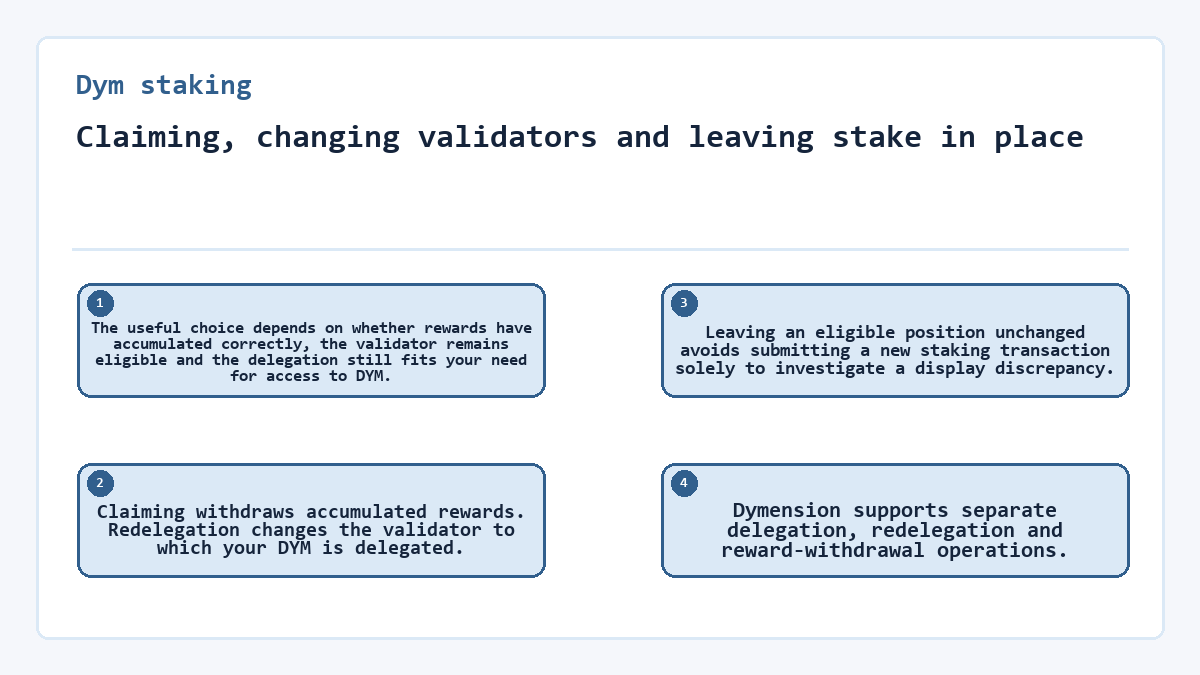
Claiming, changing validators and leaving stake in place
The useful choice depends on whether rewards have accumulated correctly, the validator remains eligible and the delegation still fits your need for access to DYM. Claiming withdraws accumulated rewards. Redelegation changes the validator to which your DYM is delegated. Leaving an eligible position unchanged avoids submitting a new staking transaction solely to investigate a display discrepancy. Dymension supports separate delegation, redelegation and reward-withdrawal operations.
| Option | Effect on the position | Relevant DYM balance |
|---|---|---|
| Leave the delegation in place | No new delegation change or reward withdrawal | Existing delegated DYM and separately accrued rewards |
| Claim accumulated rewards | Withdraws payable rewards without unbonding principal | Rewards credited to the withdrawal account |
| Redelegate to another validator | Moves delegation subject to staking restrictions | Delegated DYM remains committed to staking |
| Choose by the balance that needs to change: unclaimed rewards, validator allocation or neither. | ||
A validator change addresses future participation and commission exposure. It doesn’t recalculate earlier rewards using the destination validator’s terms.
How does validator commission change the reward calculation?
Validator commission reduces the rewards allocated for distribution before the remaining amount is shared among delegators, so a gross estimate overstates the amount they retain.
The percentage needs the correct starting amount
For a period with an unchanged commission rate, let G represent your proportional reward allocation before commission. Let c represent commission expressed as a decimal fraction. The corresponding reward after commission is G × (1 - c), before transaction costs and rounding. This relationship isolates the commission deduction; it doesn’t predict G or assume that network earnings stay constant.
A gross estimate
A figure explicitly calculated before commission still needs that deduction. The percentage applies to the reward allocation used in that calculation.
A reward balance after commission
A delegator reward balance already reflects the distribution split. Subtracting the same commission again understates the expected receipt. Transaction fees remain a separate consideration.
The applicable rate can change
A validator’s commission settings include its rate, maximum rate and permitted rate change. The maximum describes a limit rather than the charge applied to every reward. If the rate changed during the observation period, today’s setting alone can’t explain the whole period. Compare the change’s effective time with the reward interval.
Reward eligibility follows the active validator set
A recorded delegation earns issuance rewards only through an eligible active validator; appearing in an account’s staking list doesn’t establish that eligibility by itself. Dymension selects its active validators by bonded stake. A validator outside that set doesn’t qualify for the same issuance allocation. The selected validator’s status therefore matters before any comparison of commission rates.
Look at status during the period that produced the shortfall, not just at the moment of inspection. A validator can be active now without having been active throughout an earlier interval. Likewise, a lower commission can’t compensate for an interval in which the validator received no eligible allocation. Distinguish that missing allocation from a larger percentage deduction on rewards actually earned.
Claim costs affect the amount that becomes spendable
When a reward withdrawal pays transaction fees from the receiving account, its spendable balance increases by the credited reward minus those fees, assuming no other activity. Commission has already affected the reward calculation. The network transaction charge is another cost, paid for executing the withdrawal rather than for operating the validator.
Claim frequency therefore affects the total cost of collecting rewards. Compare the transaction’s fee with the amount being withdrawn instead of assuming that frequent claims improve earnings. Compounding means adding received rewards to delegated principal. A reward withdrawal alone doesn’t perform that additional delegation. The separate staking and distribution operations make that distinction observable in transaction history.
Keep enough spendable DYM for the transaction you intend to submit. Bonded principal isn’t a liquid fee balance, and an unclaimed reward display isn’t evidence that a transaction can spend it in advance.
A reward counter can reset when the delegation changes
If the reward counter falls immediately after adding stake or changing a delegation, inspect the transaction’s reward-withdrawal events before treating the fall as lost earnings. Staking changes can trigger settlement of accrued rewards through the distribution mechanism. That moves value out of the unclaimed counter and into the withdrawal account.
The new counter then represents a different accumulation interval. Comparing it directly with the earlier counter can make a successful payout resemble a sudden reduction.
Reconcile the withdrawn amount with the transaction’s actual recipient and fee. A balance read after subsequent activity may also include a new delegation or another outgoing transaction. The receipt provides the amount attributable to the withdrawal, while account history explains what happened afterward.
A successful reward withdrawal records an amount and credits the configured withdrawal address. If that address differs from the account you are watching, the expected credit belongs elsewhere.
Network issuance changes the starting reward pool
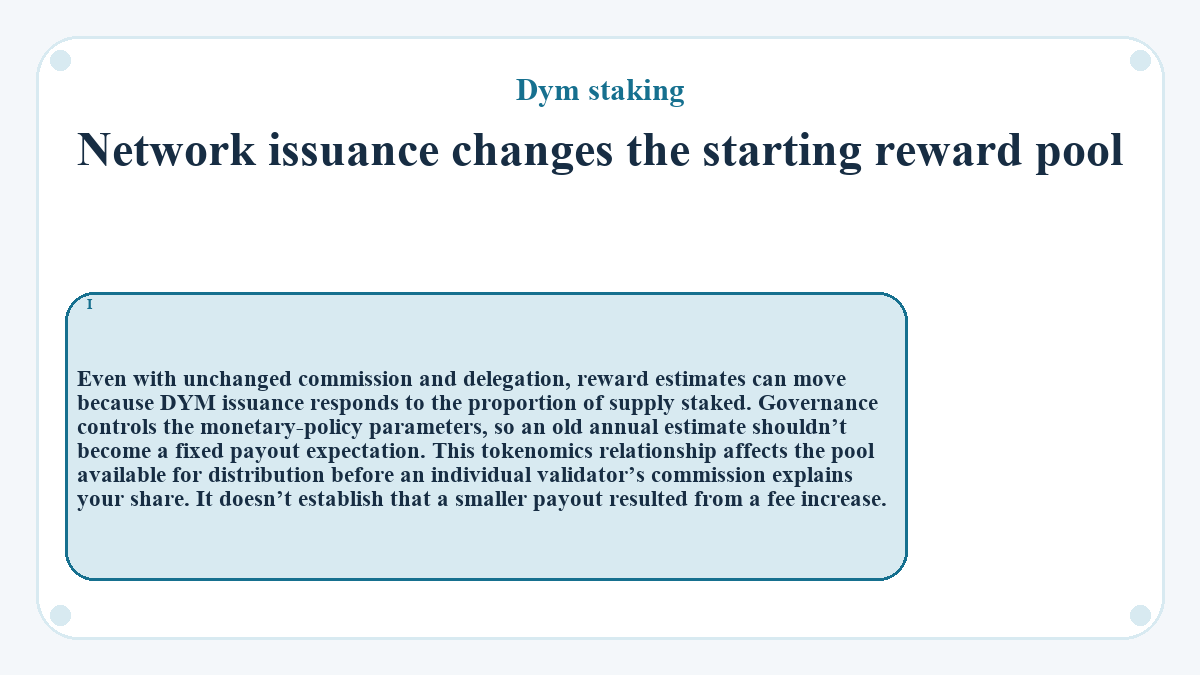
Even with unchanged commission and delegation, reward estimates can move because DYM issuance responds to the proportion of supply staked. Governance controls the monetary-policy parameters, so an old annual estimate shouldn’t become a fixed payout expectation. This tokenomics relationship affects the pool available for distribution before an individual validator’s commission explains your share. It doesn’t establish that a smaller payout resulted from a fee increase.
Why might a validator change be unavailable?
A validator change may be unavailable if your account has an unfinished incoming redelegation to the validator you want to leave.
This restriction blocks onward redelegation from that validator for your account, including stake that wasn’t part of the incoming redelegation.
Inspect the pending entry and its recorded completion time before submitting another transaction. Repeating the same request doesn’t remove the restriction. Unbonding is a separate action that starts releasing stake under the applicable rules; it isn’t an interchangeable response to an unavailable validator change. If the recorded restriction has expired but the request still fails, retain the transaction error and delegation details for diagnosis.
Records that distinguish a fee difference from missing rewards
A resolved commission discrepancy should reconcile the reward interval, eligible stake, applicable commission and actual withdrawal amount. Include transaction fees when comparing spendable balances. Include settled rewards when comparing counters across a delegation change. These checks identify whether the difference comes from the calculation, a recorded payment or an interval without eligible rewards.
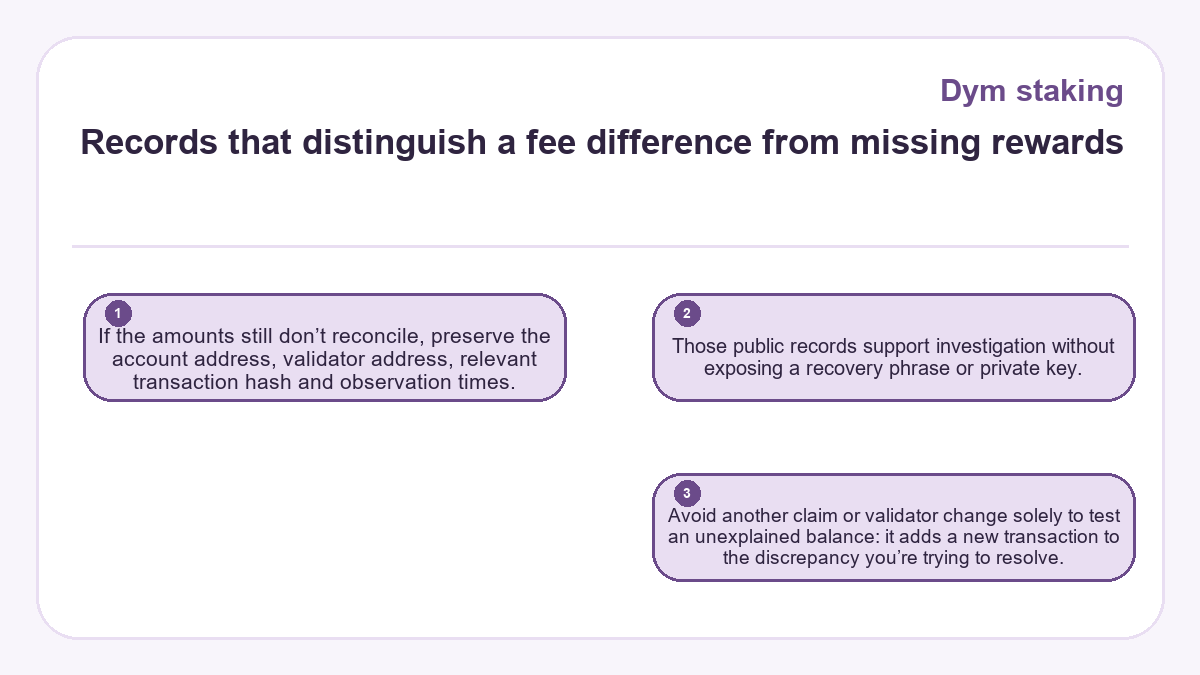
If the amounts still don’t reconcile, preserve the account address, validator address, relevant transaction hash and observation times. Those public records support investigation without exposing a recovery phrase or private key. Avoid another claim or validator change solely to test an unexplained balance: it adds a new transaction to the discrepancy you’re trying to resolve.
Questions and answers about Dym staking
Does splitting DYM between validators reduce the commission percentage?
Splitting a delegation doesn’t automatically reduce commission because each validator applies its own rate to its allocated rewards. The combined deduction depends on the rewards attributable to each delegation and its applicable commission. A simple average of advertised percentages can misrepresent that deduction when the delegations earn different amounts.
Can a validator apply a new commission rate to rewards already allocated?
A new commission rate applies to subsequent allocations rather than recalculating rewards already distributed to delegator accounting. An accumulated balance may therefore include rewards earned under different rates. Using the latest percentage for the entire interval can produce an apparent discrepancy even when each allocation used the applicable rate.
Why can a tiny claimed amount differ from the displayed reward?
Reward withdrawal rounds fractional accounting amounts down to transferable base units. A wallet may also display fewer decimal places than the underlying accounting uses. These effects can explain very small differences, but they don’t justify attributing a substantial shortfall to rounding. The recorded withdrawal amount is the relevant payment figure.
Is a validator’s minimum self-delegation my minimum staking requirement?
Minimum self-delegation is the validator operator’s own staking requirement, not a minimum automatically imposed on every delegator. It shouldn’t be used to explain your missing rewards simply because your delegation is smaller. Your recorded delegation and the validator’s eligibility determine whether that particular position participates in reward allocation.
Will leaving claimed DYM in the wallet compound staking rewards?
Claimed DYM doesn’t compound staking rewards merely by remaining spendable in the wallet. Compounding requires another delegation that adds those tokens to the staking position. If an application offers automation, the resulting delegation records must show that addition; a successful reward claim alone establishes only the withdrawal.